Camunda on STACKIT: Lessons From Running It
What running Consid's Camunda 8 platform on STACKIT taught us: the setup as code, where a sovereign cloud behaves differently from a hyperscaler, and what we would decide differently today.
Solution Architect at Consid · Camunda Champion · Hamburg
I'm a solution architect and consultant manager in Hamburg, with 14+ years in software engineering and consulting. I build process automation and cloud platforms, with a focus on Camunda. My work spans implementation, architecture decisions and helping teams run what they build.
Chapter 01 · Projects
If a problem shows up twice, the answer goes on GitHub.
Most of it started as a customer problem that needed a reusable answer, a connector or a secret provider. The rest I built for myself. The Excalidraw icon library exists because I got tired of drawing Camunda's product symbols into my diagrams by hand.
Built as code on the Schwarz Group's European-owned cloud.
A plugin that reads an OpenAPI specification and generates the FEEL expressions an Inbound Webhook Connector needs to validate payloads. I built it at a customer who let me open source it, and it runs in production there: a process instance only starts once the payload is valid. Camunda 8 bills per process instance, so an invalid one costs money and someone's time to clean it up. Keeping validation and contract in sync by hand is gone as well.
Camunda 8 had no way to handle files inside a process. This outbound connector, written at Novatec in 2023, uploads, downloads and deletes files in S3, so a process carries a reference instead of the file. Published in the Camunda Marketplace, described in a guest post on the Camunda blog, then handed over to Camunda's engineering team. Since Camunda 8.9 the product ships an official Amazon S3 connector, maintained by Camunda; my repository documents the original.
Example project showing how to test inbound webhooks with Camunda Process Test: payload mappings, authentication and whether the process instance actually starts.
Camunda, Java · Testing Inbound Webhooks With Camunda Process Test
A custom Camunda secret provider for HashiCorp Vault with token authorisation and the KV backend in version 1 and 2. The reference implementation behind the CamundaCon Amsterdam talk.
Camunda, Vault, Java, Maven
An order status use case: the Camunda 8.8 AI Agent connector orchestrates a set of tools inside an ad-hoc subprocess, with AWS Bedrock, Claude 3 Haiku and Java workers for the order data.
Camunda, AWS, Java · Agentic Orchestration with Camunda 8.8
An outbound connector that creates and changes entities in a Moco account, the agency management SaaS. Built to connect internal processes at Consid to time tracking and project data, published in the Camunda Marketplace.
Camunda, Java, Maven · Repository
An Excalidraw library with the Camunda icons for architecture sketches and slides, in Excalidraw's public library browser since October 2023.
Excalidraw, Camunda · Excalidraw libraries pull request
Community extension that runs Zeebe workers in Micronaut, one dependency away. I wrote the initial implementation, brought it into the Camunda Community Hub and maintained it there with colleagues at Novatec, among them Tobias Schäfer. Someone else looks after it today.
Camunda, MICRONAUT, Java, Gradle
Chapter 02 · Tech blog
I write up what I learn: 50+ articles so far.
Two tracks. The None Start Event for people starting out, The Intermediate Catch Event for people who run Camunda 8 in production. A post usually begins as a problem from a customer project, sometimes as something I broke on my own machine on a Sunday afternoon.
From A Proof Of Concept To Right-Sized Environments Without A Blueprint · Advanced track
Making A First Deployment Reproducible With Terraform And GitOps · Advanced track
An Overview Of The Most Important Changes · Advanced track
What It Is And What It Isn't. · Advanced track
What Changed And What It Means For You · Advanced track
How Cloud Sovereignty Became An Operating Decision · Advanced track
How We Secured Camunda And Ensured Stability Over The Whole Platform · Advanced track
All posts on Substack New posts appear on Substack first and are also published on Medium.
Named after the simplest BPMN trigger: no preconditions, just getting into it. For readers who are new to BPM, BPMN and Camunda. Started in May 2025.
For engineers and architects who run Camunda 8 in production. One practical lesson per post, usually with code and a real failure mode.
One vacation request, twelve parts, the whole notation.
From a BPMN model to a running process.
A sovereign Camunda 8 platform, built as code.
Chapter 03 · Talks
Every talk here comes out of something I built.
Conferences, meetups and twice a year a lecture hall at HAW Hamburg. Fourteen years at customers and companies leave plenty to report, mistakes included. Those are the parts people ask about afterwards.
What running Consid's Camunda 8 platform on STACKIT taught us: the setup as code, where a sovereign cloud behaves differently from a hyperscaler, and what we would decide differently today.
In the lecture hall: an insurer's claims agent, built with a coding assistant, settles claims on its own. DORA shows what breaks, and the rebuild with BPMN and Camunda Operate fixes each point.
ProcessOS puts AI agents across the whole process lifecycle. The lecture starts at the automation ceiling, 71% of companies run AI agents and 11% get them into production, then follows Camunda's quote-to-cash rebuild.
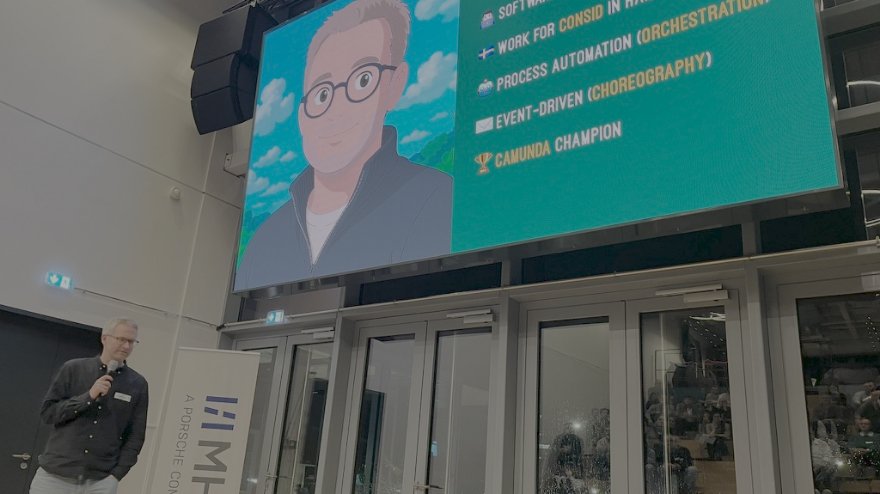
Cloud sovereignty is a legal question before a technical one. The CLOUD Act reaches European subsidiaries of US providers, STACKIT is European-owned, and then comes the build: Camunda 8 Self-Managed on Kubernetes.
For a room of banks and insurers: an agent that settles claims on its own, held against DORA, the EU's resilience act for the financial sector, then rebuilt with BPMN and Camunda Operate.

Agentic AI for a room of Scrum Masters: what BPMN is, why the agent should not do all the work, and a live demo of an order support process where the agent finds the parcel.
What an agent needs inside a process: a clear goal, tools, dynamic processes. Hands-on demo with a BPMN process and AWS Bedrock, including what the model calls cost.

How a customer in critical infrastructure runs Camunda on Kubernetes with HashiCorp Vault as the single source of secrets: separate connector and job worker runtimes, secrets loaded at startup.
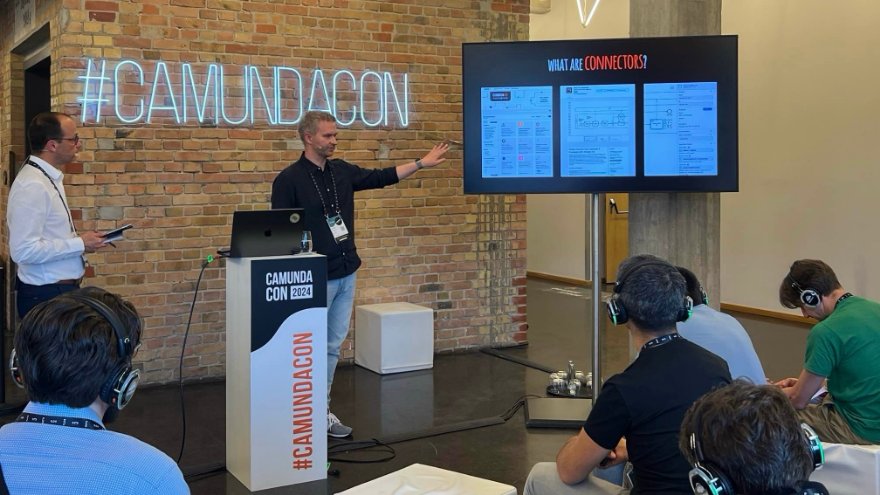
Preview of the CamundaCon session at our Hamburg office. Hardcoded credentials are the risk; the talk covers central secret stores, retrieval patterns, caching, and where connectors differ from job workers.

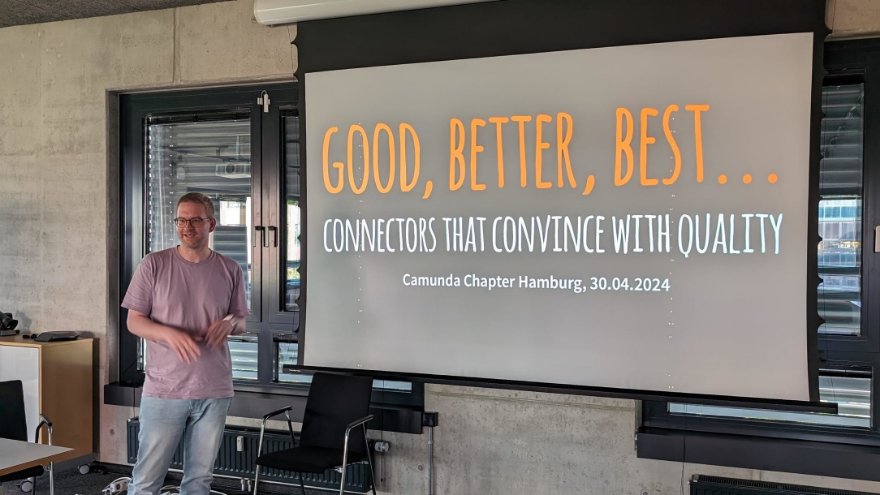
More than half of the connectors in the Camunda Marketplace had not been updated since 2023. The lightning talk names the quality signals that matter and calls low-code connector work pro-code software development.

German-language preview of the CamundaCon Berlin talk: how to judge a marketplace connector before it goes into production, and what to do differently when building one, with the AWS S3 connector as the example.
Chapter 04 · About
From Java backend to AI and cloud platform architecture and team leadership, in fourteen years and four roles.
Software engineer first, then process automation, platform engineering and solution architecture, with a team to lead since 2022. Since 2025 a growing part of the work is AI agents inside business processes.
I'm a consultant and architect in Hamburg. I started in 2012 at Novatec Consulting: first a Java developer for a pharmaceutical wholesaler, then six years in the DevOps team of a container shipping company. That is where I learned what it costs to keep a system running that other people depend on.
Process automation got hold of me twice: in my diploma thesis at Ulm, a small process engine, and in 2019 at a large insurer, where we replaced IBM workbasket components with Camunda 7 and Taskana. I never left the field after that.
Since 2022 I've combined engineering work with leading a team, and Camunda is not the whole story. I built a Confluent Kafka data platform on AWS for a global logistics company, then a Kafka streaming architecture for a large e-commerce platform, correlating data across topics and migrating services.
Since 2024 I'm a consultant at Consid, a Swedish consultancy in Hamburg, and at customers I take on different roles, mostly solution architecture: Camunda 8 platforms and, since 2026, Camunda on STACKIT, a platform I designed and built myself, from a proof of concept modelled on the AWS reference architecture to Terraform, GitOps and the hardening that made it production-grade. I still write the code myself, increasingly alongside a coding agent that can open a pull request but never merge or apply; the pipeline gates it exactly as it gates a person.
A growing part of the work itself is AI agents inside BPMN processes, with a goal, tools and boundaries, so that someone can still audit what happened. Outside of projects I write two newsletter tracks on Substack, speak at CamundaCon, the Camunda Chapter Hamburg and HAW Hamburg, and am a Camunda Champion.

Within the Camunda and STACKIT partnerships: evaluating both platforms for operating models and integration, and building Consid's own platform on them. The architecture is the featured project under Projects.
An IT service provider in the energy sector moves its custom ITSM process system to Camunda 8: legacy code to Java, processes remodelled in BPMN, secrets in Vault, deployment on Kubernetes with ArgoCD, trainings for the business units.
For a group with companies in construction, energy and agriculture: solution designs for portals, CRM and ERP integration, integration architecture and non-functional requirements. Code and architecture reviews of external vendors, plus the operations concepts and documentation that belong to a design.
MVP of the platform as infrastructure as code, self-service for teams, application onboarding, message format guidelines. Then an evaluation of Apache Camel and Apache NiFi for the synchronous APIs next to it.
Evaluated Camunda 8 SaaS as an integration platform for a renewable energy company. The requirement: a process solution that handles documents and connects to several systems. Prototyping showed that Camunda 8 still lacked some of the needed features in 2024, document handling out of the box among them. That result became the basis for the customer's tool selection: no Camunda for that role at the time.
Connectors and element templates in Java: AWS S3 file handling, an ERP integration, standards for tests and docs. Camunda's engineering team later took over the S3 connector; since 8.9 the product ships an official one.
Architecture and design of several Java services after a data model change: correlating data across topics with Kafka Streams and KTables, migrating three applications, coaching the teams.
IBM workbasket components replaced by Camunda 7 and Taskana, DMN-based task routing, comparison tests keeping the customer API stable. Java, Spring Boot, Kafka, Apache Camel.
In the DevOps team of a container shipping company: database, build system, continuous integration and delivery, release management, automated deployments, test environments, performance.
Migration of the ordering interface between pharmacies and the wholesaler to the MSV3 standard: SOAP interfaces defined, built, tested and connected to the legacy backend.
Customer projects are described by industry, not by name.
Logos are trademarks of their respective owners and only indicate the products I work with.
Chapter 05 · Certificates
Certified in the stack I run in production.
These certificates sit next to the project work, the articles and the talks. They give a customer one more way to check what I know about the platforms I work on, and they are the one thing on this page I did not write myself.


Ideas, projects, feedback, a talk or a workshop, or anything else worth sharing. You can reach me on LinkedIn.